July 14, 2026
Quick Summary
A regulation bocce court measures about 12 feet wide by 60 feet long, though backyard versions often shrink to fit smaller lots. Building one with artificial turf skips the constant leveling and raking that sand or gravel courts demand, while giving players a consistent, true roll every game. The right turf pile height, infill, and border materials turn a weekend project into a court that plays well for years.
Few backyard additions bring people together quite like a bocce court, and learning how to build a bocce ball court with artificial turf is easier than most homeowners expect. Traditional bocce courts use crushed stone or sand, both of which shift, puddle, and need constant raking to stay level and playable.
Swap that surface for synthetic turf, and you get a court that plays consistently game after game, drains fast after rain, and skips the raking altogether.
Why Artificial Turf Works So Well for Bocce Courts
Bocce is a game of touch and precision, and every roll depends on a flat, predictable surface. Sand and crushed stone courts look great freshly raked, but they shift underfoot, develop low spots, and throw off the roll within weeks of regular play. Rain turns loose stone into a soggy mess, and weeds work their way through the gaps regardless of how often you clean them out.
Turf solves the consistency problem at the source. A properly built turf court stays flat season after season, with no raking, weeding, or re-leveling required. The surface plays the same in July as it does in November, which counts for a lot if you're hosting regular games with family or neighbors.
Bocce Court Dimensions and Layout Basics
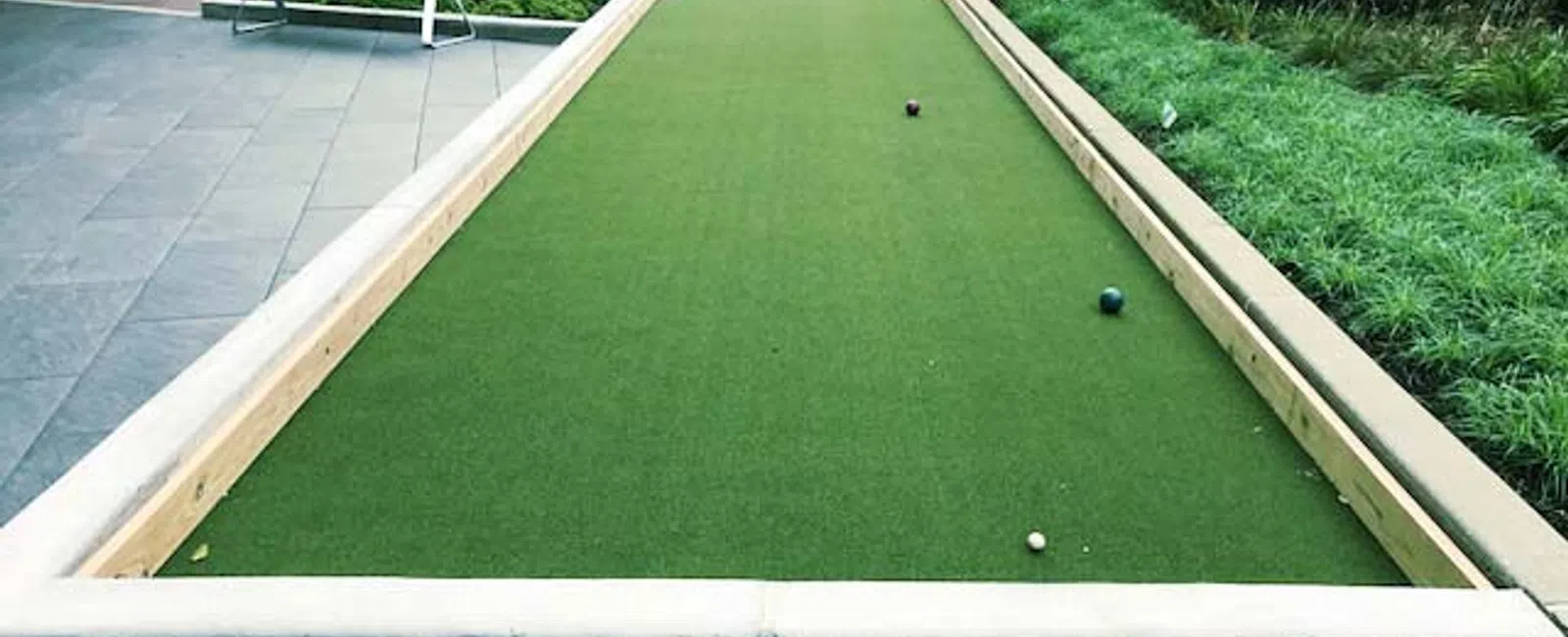
A regulation bocce court runs about 12 feet wide by 60 feet long, though official tournament courts can stretch closer to 13 by 91 feet. Most backyard builds shrink those numbers to fit available space, with 10 by 40 feet being a common size for a casual home court. Length affects gameplay more than width, so if space is tight, trimming the length slightly still keeps the game enjoyable.
Before laying anything, mark out your court boundaries and check for a level base area. A slight slope isn't the end of the world, but a court with a noticeable grade in one direction will cause balls to drift consistently toward one side, throwing off every shot.
Base Preparation and Materials
Like any turf project, the base underneath the bocce court decides how long it lasts and how well it plays. A standard build includes:
- Excavating the marked area to a depth of roughly 3 to 4 inches
- Laying and compacting a crushed stone or aggregate base, graded flat
- Adding a thin leveling layer of stone dust or fine aggregate for a smooth top surface
- Installing the turf with a taut, stable fit and secured edges
Skipping the leveling layer is a common shortcut that leads to small dips and unpredictable rolls once the court sees regular use.
Choosing the Right Turf Pile and Speed
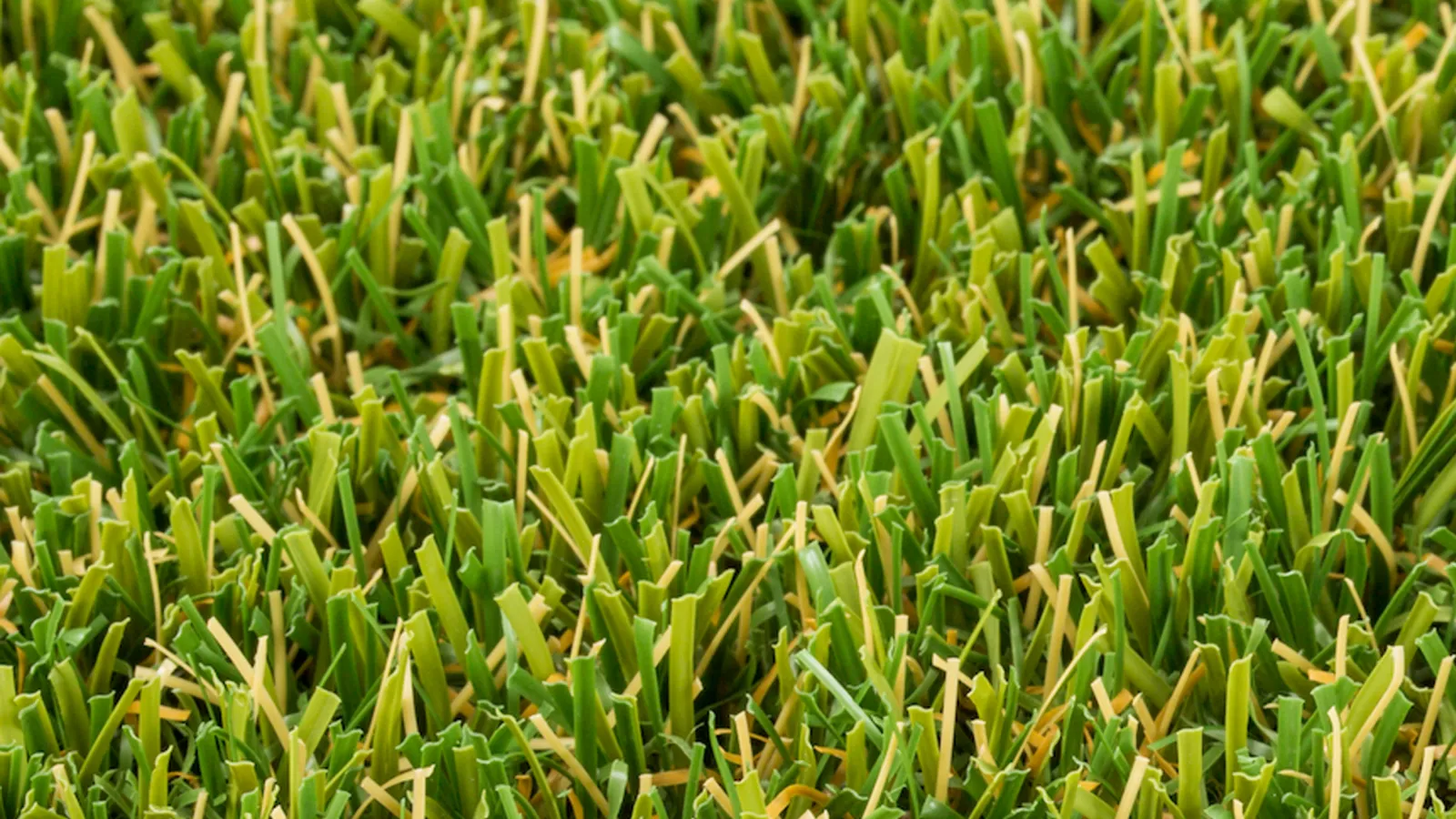
Bocce plays best on a short, dense turf pile, generally in the 3/8 inch to 5/8 inch range. Taller turf slows the ball down unevenly and makes precise shots harder to judge. Look for a product that is tight and low and built for smooth ball roll rather than a lush landscape look.
Some turf suppliers offer bocce-specific blends designed to mimic the speed of packed clay or fine gravel, which gives players the truest experience on the court.
Borders, Backboards, and Finishing Touches
Most bocce courts use a raised border, often wood, composite, or aluminum, to keep balls in play and give the court a finished look. Backboards at each end help contain wild throws and let players bank shots off the ends, adding a layer of strategy to the game.
Lighting is worth considering too if evening games are part of the plan, since a few well-placed fixtures stretch playable hours well into the night.
Maintenance Once It's Built
Turf bocce courts need very little upkeep once they're installed. A quick brush of the fibers every few weeks keeps the blades standing and the roll consistent, and a hose-down clears off pollen, dust, or leaves after a windy afternoon.
Unlike a stone court, there's no need to rake lines back into place after every game or haul in fresh material each spring. Snow can be cleared straight off the surface without harming the turf underneath, so the court is ready again as soon as the weather breaks and the sun comes back out.
Why It's Worth the Investment
A turf bocce court holds its value in ways a sand or stone court never will. There's no annual re-raking, no weed control, and no re-leveling after a rough winter. The court is ready to play the moment guests arrive, rain or shine, and it adds a real gathering spot to the backyard, one that gets used far more than a patch of lawn ever would on its own.
Family gatherings, block parties, and quiet weeknight games all get easier once the court is one less thing to maintain.
Build Your Bocce Court with Turf Tek USA
At Turf Tek USA, we build bocce courts the same way we build every project: with a base engineered for Northeast weather and a turf product chosen for how the game plays, not just how it looks. Our crews handle excavation, grading, and turf installation from start to finish, so you get a court that rolls true from day one and stays that way for years.
Backed by our installation warranty and a team that's installed athletic surfaces across Long Island, Westchester, and Connecticut, we keep the process simple from measuring your yard to laying the final border. Give Turf Tek USA a call for a free estimate and let's get your bocce court built right.